Wednesday, March 18, 2009

New Website


Dear Visitors,
Update your bookmarks because Cool Mum Super Dad has moved on to its own hosted site at http://coolmumsuperdad.com/!

All the content from this blog are currently being transferred to the new site. This blog shall no longer be updated but will be kept open.

Tuesday, March 10, 2009

Sibling Rivalry

Sibling rivalry has far-reaching consequences in our lives!

Jamilah will talk on Sibling Rivalry on Friday, 20th March 2009 from 3pm till 4pm at bfm89.9 (business station).

She will highlight how parents' attitudes (what they say and do) can create conditions which can diffuse sibling rivalry or make it worse.

Thursday, March 05, 2009

"Where Can I Get COOL MUM SUPER DAD?"

Some people have complained to me that they can't find my book Cool Mum Super Dad and/or its Malay version Ibu Kool Bapa Hebat. Technically speaking, both books should be on the shelves of all major bookstores.

If you face the same problem, you may write to me at jamilah.samian@gmail.com for an online order. Postage is free.

Tuesday, February 24, 2009

Highly Sensitive Children

Jamilah will be on air (radio station bfm89.9) on FRIDAY, 6th of March 2009 from 3pm till 4pm to talk about Highly Sensitive Children (HSCs).

Specifically, she will discuss

- what the term "Highly Sensitive Children" means and how to recognise if your kid is one
- how HSCs are different from nonHSCs
- what parents / caregivers / teachers can do to help unleash the hidden potentials of HSCs.

Wednesday, February 18, 2009

Confirmed Public Programmes

Jamilah will be giving FREE public talks as follows:

1) Parenting Talk: Cool Mum Super Dad
Venue: Tunku Abdul Rahman College (TARC)
Time: 6.30 pm - 8 pm
Day / Date: Thursday, 26th March 2009

2) Parenting Talk: Teens & Sex
Venue: Universiti Tunku Abdul Rahman (UTAR), PJ campus
Time: 9.45 am - 12 noon
Day / Date: Saturday, 16th May 2009

3) Title: Work Life Balance
Venue: Tunku Abdul Rahman College (TARC)
Time: 6.30 pm - 8pm
Day / Date: Thursday, 28th May 2009.
(co-speaker: Ahmad Fakhri Hamzah)

To register, please call any of the respective numbers listed in the flyers.

To register for the talk on 26th March 2009, please refer to the contact details stated in the flyer for TARC.

To enlarge any of the flyers, click on the image once.


Flyer for Parenting Talk: TEENS & SEX at UTAR, PJ.
Date: 16th May 2009.


Flyer for Work Life Balance Talk at TARC.
Date: 28 May 2009.


Thank you.

Why Kids Misbehave

To listen to Jamilah's interview at bfm89.9 on WHY KIDS MISBEHAVE, check out the podcasts below:

Are You Struggling To Be A Cool Mum Super Dad? You Are Not Alone!


Why Your Child Is Misbehaving And How To Get Them To Behave Better.   

Tuesday, February 10, 2009

Radio Show on "Why Kids Misbehave"

Jamilah will be on air (new radio station bfm89.9) on Friday, 13th February 2009 @ 3 pm till 3.30 pm to talk about "Why Kids Misbehave" and what parents can do to deal with it better.

Tune in for a lively and engaging discussion!

Sunday, February 01, 2009

Toastmasters: Overindulgence is Good for a Change

by Jamilah Samian

Can you overindulge in gastrointestinal delights and devour every bit of tasty morsel in a multicourse meal and still remain as healthy as ever? Yes, you can.

How do you go on a food binge that lasts for three straight hours and not gain an ounce of fat? That's exactly what the second meeting for MIM Toastmasters 2009 was all about.

Fine dining began at 9.30 am sharp, with Toastmaster K. Geetha dishing up the Appetizer to tickle everyone’s taste buds with a simple invocation. Then came Chef d’ Meeting, Advanced Communicator Silver (ACS) Ahmad Fakhri Hamzah, aptly dressed as a chef from head to toe. Ahmad caught everyone off guard when he struck the top of the rostrum with a ladle. The standard gavel had been put on hold for a day. Ahmad talked about how Dr Ralph C. Smedley, Toastmasters International founder, concocted a recipe on how to be a good speaker at the basement of an apartment in Santa Ana, California in 1924.

Move aside, gavel. Here comes the ladle.

Next up was Restaurateur Lee Sai Keong, Acting President. Instead of delivering the usual Presidential Address, Sai Keong asked each member of the audience to respond to the question: "Do we EAT TO LIVE or LIVE TO EAT?"

The audience then feasted on a delectable round of table topics whipped up by Toastmaster Alia Nadhirah Ahmad Fakhri who, with an apron smartly tied to her waist, was Maitre d' Table Topic. True to the occasion, Alia came up with dainty ideas to go with the flow: "The best dish you ever made", "You're a waiter at a restaurant and the customer says, 'There's a fly in my soup!' How do you react?", and "The best meal I ever had."

The Entertainer of the Day, Daniel Teh, had the audience in stitches with his down-to-earth humour before the 20-minute coffee break, when those present helped themselves to aromatic nasi lemak plus a healthy dose of networking and fellowship.

For the main entree, three main courses were served:
- Chef de Cuisine Anne Yuen presented Menu No. 6 from the Advanced Communication & Leadership (AC&L) Manual.
- Chef de Cuisine S. Krishnan did Menu No. 8 from the Communication & Leadership (C&L) Manual.
- Chef de Cuisine Jamilah Samian did Menu No. 3 from AC&L. Jamilah was voted Best Project Speech Speaker of the Day with her speech entitled "Cost of a Miracle."

(L-R) Past President Mark Ho, TM Lee Chor Kee, ACS Ahmad Fakhri, Vice-President (Education) Lee Sai Keong, CC Jamilah Samian, CC Richard Hoy, ATMB Abu Bakar Bapoo

The Cuisine Critics, Word Nutritionist, BAHtender, Time Inspector and Chief Chef all had their say in the end. What a great way to end a sumptuous meal!

"This meeting was an experiment," Ahmad says. "I wanted to do something out of the ordinary. I thought: Why not create a unique atmosphere, say, once a quarter, to spice things up?"

The idea to set up a restaurant setting for a meeting had been percolating in his mind for months and took several days of research. "I looked up some of the terms frequently used in the culinary world and coined the rest. You can do it with a fair amount of creativity."

With his role as Chef d' Meeting (Toastmaster of the Day), Ahmad accomplished a Specialty Project and is one step closer to becoming an Advanced Communicator Gold.

"I began with the end in mind: Enrichment of vocabulary, being able to move beyond our comfort zone and dabbling with unfamiliar territory. I wanted the audience to use as many senses as possible in brewing words and phrases that evoke emotions, sights and smells peculiar to the culinary realm," he says. "It's in line with the theme of the day: CULINARY ARTS."

"It's also to tie in with Chinese New Year, when gastronomy is an important element in enhancing friendship and amity among family and friends," he says. "It's food for thought for other Toastmasters clubs. If you find the usual Toastmasters meeting becoming a tad too mundane, it's worthwhile to cook up something fresh and engaging."

Prior to the meeting, the audience was given a list of phrases and words they were encouraged to use like "spice up", "digest the message", and "garnish."

The guests found it stimulating, too. "It was a success because of the preparation," says Daniel Teh, who doubled up as Chief Chef (General Evaluator).

What's next?

"We'll see if we can come up with Law & Order, ER (Emergency Room), and The Art of War," says Ahmad.

Saturday, January 31, 2009

What a Reunion!

Catching up with your former schoolmates is invigorating for the soul, I learnt today.

I remember the first email I received from Dr Noral, now at the Institute of Medical Research (IMR). She used to sit just in front of me in class. "Do you remember me?" she wrote via Facebook. Of course I do! You don't forget people you grow up with that easily.

That sparked off a search for other schoolmates and over the course of just several days, things swirled into a frenzy. Emails flew from as far as Canada and criss-crossed the globe and before we knew it, the date was set ... 31st January in Putrajaya! How lovely it was to see June, Mani, Baya, Rosnah, Masita, Masjuniyati, and Nora, to mention a few. Never mind widening waistlines. The bright smiles and toothy grins brought back fond memories among bosom buddies in a flash, though it wasn't quite total recall for some.

It's a kind of closure, after all these years of wondering what had happened to everyone ... and NOBODY could care less about how many titles or degrees others had. Such a simple reunion; potluck for that matter, yet I had a blast. And to think all this while I thought I was the only nostalgic person around ... Boy (errr ... I mean, girl), am I glad I was wrong!

Several of the girls brought pictures of our schooldays ... it was a good walk down memory lane. Still, it's sad to learn that a few had passed on due to natural illnesses and other causes. I, on the other hand, did not have any pictures to share; I must have misplaced them as I have moved so many times after secondary school. It's also good to know that everyone is doing well. A few are keeping real busy with family (like me), others are medical specialists, lawyers, teachers and businesswomen ... I feel so proud of ALL of them!

Just before we left for Putrajaya, Fakhri said, "Why don't you bring some of your books?" I was aghast at the thought. Bring my books? This isn't a business meeting! "Honestly," he said, "I think they would love to see it."

Well, I did put some in the car boot ... and forgot all about it, until someone asked me. "Didn't you bring any?" she asked.

In the end, there wasn't enough to go around and I promised to send the books by snail mail.

Last I heard before I left, another reunion is in the cards.

Thursday, January 29, 2009

Next Book on TEEN Boys ... Out in May 2009!

Just heard from my publisher today that they're keen to publish my next book.

Targeted date of completion: Mid 2009, God willing. Anytime sooner is a bonus.

It's kind of a sequel to my first book, COOL MUM SUPER DAD, but this time I'm focusing on TEEN BOYS.

The book is an ideal read if you have a tween (10 plus to 12) or a teen (12 plus to 19) son.

Can't wait to see the book in print and hold it in my hand ... Have been working on it for sooo long. Put my heart and soul into writing it.

To everyone who has been enquiring and wondering ... thank you for all your support and prayers.

Monday, January 19, 2009

Second Book Coming Up!

Phew! Finally, I'm almost finished with revising the draft for my second book ... yet again. Just have one more section to complete. This time, after I got feedback from an editor. I have lost count how many times I have revised the copy. I don't know about other authors. For me, it's a l-o-n-g process of writing, putting it into the cold, followed by rewriting. Many times, that is. Sometimes I go to bed at night wondering if the book will ever get published. Yet I will wake up each morning convinced that it will!

As Paulo Coelho said, "When a person truly desires something, the whole universe conspires to help that person realise his dream."

Wishful thinking in difficult times like this? I think not. Good times or bad times, it's always those who have faith in themselves who succeed.

Anyway, a tip for aspiring writers:

Some time ago I stumbled upon a book by Sol Stein entitled "Stein on Writing". It's a lovely read and worth your time. Doesn't matter if you do fiction or non-fiction. Stein has done both. In fact, one thing I learnt from him was that you could do both equally well. I used to think if you're into non-fiction, you can't shine in fiction and vice-versa. Glad to discover I was wrong!

AmBank Toastmasters

Last Thursday evening, Ahmad Fakhri and I fulfilled a commitment we made some months ago to support AmBank Toastmasters Club. Great to catch up with Mah Foong Hoh, Jean Soong and Kala among others. As Chinese New Year (non-religious celebration) was just round the corner, the Sargeant-at-Arms had the whole place donned accordingly. Everything was red (a Chinese friend once remarked "The redder the better") and everyone received an orange as a door gift. How sweet! Miss President (Jean) even taught us some Mandarin and Cantonese greetings ... "SAN LAI FAI LOCK" and "SIN LIEN KWAI LUR". I do hope I got that right...

As the Grammarian, I asked the audience if they had watched Mulan. Some did. There was a particular scene I remember in the movie, in which the Emperor of China said, "A single grain of rice can tip the scale". What has this got to do with Toastmastering? Just as a single grain of rice can tip the scale, so does a single word can make or break your speech. This is not an exaggeration. Think about it. When you string words together, you get a sentence. Join these sentences, you get a paragraph ... and eventually, a speech. It's the quality of each word you use that makes all the difference.

Having said that, grammar is just one part of giving a speech. If you're not confident of your grammar skills, not to worry too much. The more you are anxious about getting it right, the more you stumble on the words. But if you are willing to take the risk of making mistakes in front of others (provided you're prepared), you have nothing to fear. Everyone can and will go as far as he or she is willing to work for!

Monday, December 15, 2008

Toastmasters International Youth Leadership Program

Just completed the MIM (Malaysian Institute of Management) Toastmasters International Youth Leadership Program with other Toastmasters volunteers from 12th to 14th December 2008! I was a presenter and mentor. There were a total of 26 participants, ages 15-19. Tiring but rewarding. It's amazing what the kids could achieve in three short days. Program covered leadership skills with special focus on public speaking. Normally held twice a year. Next one will be in June 2009. Much positive feedback from both participants and parents/guardians. A little encouragement goes a long way!

Parents frequently asked if their kids could join Toastmasters. The answer is Yes, if he/she is eighteen years or above. For those of you not familiar with Toastmasters, it's a speaker's club. Great to help those butterflies fly in formation if you're nervous about speaking before an audience. There're lots of Toastmasters Club in Klang Valley. Some organisations also have their own Toastmasters Club to to encourage their employees to brush up their communication skills. If you want to join, look for a club near you. Meeting Hours and Venue are different from club to club.

MIM is one of the biggest clubs and open to the public. We meet every first and third Saturday morning, 9.30 am to 12.30 noon. Guests welcome.

Monday, October 06, 2008

Talk at UTAR

Someone asked why I haven't been updating my blog regularly. My apologies ... I have been so caught up in writing my next book which I aim to complete soon.

Recent Programme: My husband Ahmad Fakhri and I ran a two-day WORK LIFE BALANCE workshop on 29th - 30th July 2008 at Boulevard Hotel Midvalley. He gave the corporate perspective and I gave a personal one. Participants were a good mix. Met with some wonderful people from the health, insurance and tourism industries, among others. It was mutual learning. We learnt from them as much as they learnt from us!

Coming Up Next: On Saturday, 18th October 2008, 9.45 am, I will be giving a parenting talk at UTAR, Petaling Jaya. Do come if you have time. If you happen to read this, please spread the word about the talk.

Programme Details:

Time: 18th October 2008 (Saturday), 9.45 am - 12 noon
Venue: Universiti Tunku Abdul Rahman (UTAR)
Centre for Extension Education
11, Jalan 13/6, 46200 Petaling Jaya

Admission is FREE and open to the public but registration is on first-come-first-served basis.

If you would like to attend, please contact Ms Eileen / Mr Ooi at 03-7957 2818 / 7955 5181 ext. 8663 / 8611. Email cee@mail.utar.edu.my

Thanks a lot :)

Friday, June 20, 2008

Noteworthy New Zealand


by Jamilah Samian

My family and I went to New Zealand recently for 14 days from 23/5/08 till 6/6/08. We clocked in more than 2,900 km, stayed in a campervan, roamed the beaches, cities, towns, gorges and farms in the North and South. What an adventure! These notes are kept brief and straight to the point on purpose and are for your benefit if you plan to do a similar trip in future.

PreDeparture

To make the trip more fun and meaningful, everyone was assigned special tasks. Ahmad Fakhri - Overall Program Manager; Me - Food Coordinator; Alia (age: 17) - Financial & Medical Coordinator; Safi (14) - Journey Coordinator; Syarif (12) - Prayer Schedule & Gadget Coordinator; Siraj (9) - Airport & Weather Coordinator.

Day 1

Touchdown: Outside Auckland Airport
Clockwise from left: Syarif, me, Safi, Alia, Siraj

Disembarked at Auckland and greeted by cheerful Dave who brought us to the KEA Campers headquarters. Took more than an hour to go through paperwork and inspect campervan. It’s awesome! The one we booked was 6-berth - the biggest they had. Facilities provided in the campervan included: toilet-cum-shower, vacuum cleaner, kitchenette (gas cooker with hood, microwave oven, sink, cutlery and crockery for 6, fridge), drawers to stow away clothes and personal items, electric heater, pillows, blankets, duvets, towels. Extra towels, blankets, pillows can be provided at no extra charge. At night time, the top berth can fit two persons. The two tables can be converted and transformed into two more twin beds. Glad we only took duffel bags as these are collapsible. Otherwise, storage would have been a problem.

Mega mighty machine: The six berth campervan


A house on wheels: Inside the campervan

First stop at Takapuna Holiday Beach. Night was pretty cold as it’s prewinter but we quickly got used to the weather. Some camping sites charge per head. Others per family. Went to Food Town (open 24/7) for groceries.

Day 2

Still in Auckland. Found Borders Bookstore, biggest in New Zealand. It’s a challenge to drive a vehicle this size around the city (plus it’s manual and neither of us have touched the wheel of one for years) but Ahmad finally succeeded to find a parking space. Encountered a flea market next to Borders. Items sold at bargain prices e.g. puzzles, winter coats, Maori products made from tree barks.

Borders: biggest bookstore

Lunch at Kampung Delights along Albert Street, a Malaysian restaurant patronised by Malaysia Airlines cabin crew and Malaysian students. A choice of rice and two selected dishes for one person cost about NZ8. Quite reasonable. Halal Indian cuisine available downstairs.

Met up with a lovely couple, Roshidah (a chartered accountant) and Richard (an engineer) and their kids, Adam and Aishah. Roshidah bought halal hotdogs and chicken for us. Richard and his team published Auckland for Muslims: A Guide for Islamic Places and Services. Was told they exacted high standards during research to ensure the halal requirement is adhered to, so look out for this guide. The booklet is produced by the Mount Eden Islamic Information Centre. For enquiries, write to enquiry@islamicinfo.org.nz Or, visit them at www.islamicinfo.org.nz.

At the table from left: Alia, Roshidah, Pn Fatimah (standing), me,
Ahmad Fakhri, Adzreen (Pn Fatimah's son)


From left: Ahmad, Adzreen and Richard

Had sumptuous dinner of ciabatta (fluffy bread), sup ekor, macaroni and soup, spicy tuna sandwiches, and veggies washed down with pengat pisang with Richard & Roshidah, and Pn Fatimah & En Aziz and their wonderful families. If you are in Auckland and need a Malaysian place to stay, don’t look any further. Kak Timah and En Aziz run Mesra Homestay which offers 6 clean and comfortable double bedrooms. For enquiries, write to mesra_homestay@yahoo.com or visit their site www.mesrahomestay.nz. Heard that Kak Timah makes the tastiest ayam percik in town. Was advised that if you’re going North and South, rule of thumb is 1:3 i.e. spend a third of your time in the North and the rest in the South. Had the first taste of cleaning up the campervan. The indicator will tell you how much waste, water etc you have. There’re special chemicals that are provided to clean the waste cartridge. It’s easy. Daily checklist: Water, Fuel, Oil, Tyres (Air), Waste, Electricity Supply. Water, fuel and gas filled up to the brim. Left Auckland. Took Waikato Expressway for Rotorua. Passed Cambridge town which was really pretty. Passed rolling hills everywhere. Enchanting forest at Mamaku Forest Park.

Day 3

Spent the night at Rotorua Top 10 Holiday Park. It’s next to Kahukura Sports & Rugby Club. The Kiwis are much into rugby it seems. Walked to the mud park which has bubbling and steaming hot geysers. Just discovered that the shower has a timer of 8 minutes. Stay any longer and there won’t be a single drop of water trickling from the shower unless you have someone who can reset the timer for you. Part of the effort on water and energy conservation, I presume. Found out later that this isn’t true of all Top 10's. Some let you use the shower for as long as you like.

Off to the Agrodome for a live demo on sheep shearing and farming. After the demo, a guide, Grant drove us to the farm. On the way he told us that petrol prices in NZ have been raised three times in the past month! He asked: How do you justify the petrol hike? We shrugged. We don’t know either… Fed and made friends with llamas, sheep, deer and cattle. The cattle are humongous. They are at least twice the size of their Malaysian cousins! Went to a Kiwifruit organic farm and had some feijoas (a special Kiwi fruit that resembled the guava). Then to the Gondola and luge ride.

Live: demonstration on sheep shearing and farming at the agrodome


At the organic farm

Next stop: Te Puia. Had a Maori welcome at the Maori Village. The traditional Maori welcome is to touch noses. Took a guided tour to the geothermal area. Top spot was where the stones felt warm to the touch. Left Rotorua for Lake Taupo. Stopped at Huka Falls, an hour’s drive from Rotorua. A must-see spot, quite unlike anything we’ve seen. You can go for white-water rafting here if it’s not too cold.
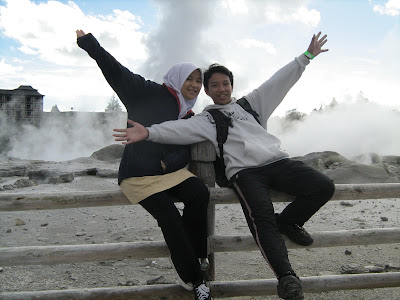

Geysers in action complete with pungent smell!

Back on the road and passed by snow-capped mountains. There is a certain allure to these mountains. Air is so clean and fresh. I could feel it in my bones! Stopped at Turangi to check tyres. Passed barren desert at Ruapehu district. Reached Palmerston North at dusk. Ahmad’s cousin, Thaharah, a post-graduate student, lives here with her husband Taufiq and three kids. Gave them the four bottles of kicap as requested by Ayah Alang. What a dinner they prepared us! Sambal tumis udang, beef curry, briyani rice with cashew nuts and barbecued chicken, stir-fried mixed veggies, salad, dhall curry, popadum, and mango juice. Brought us to Pak & Save the next day.

Passed Paekakariki when it started drizzling. When the sun shines, it does so with such brilliance. The Kiwis actively promote road safety. Encountered reminders and stark messages along the way e.g. “DRINK & DrIvE”, “TIRED DRIVERS DIE”, “DRIVER REVIVER”, “SEAT BELTS ARE LIKE HUGS. KIDS NEED THEM”, “YOU‘RE A LONG TIME DEAD. SO WHAT'S THE HURRY?”. Reached Wellington in the evening. Some days we spent on the road. Some days we enjoyed the place. As much as possible we avoid traveling at night for safety reasons. Dusk is about 5.30pm so we make it a point to be off by 7am. Tomorrow we will make our way to Te Papa.

Day 5

The GPS we rented (NZ75 rental and NZ450 refundable deposit) helped us to get to the campsite after a bewildering ride through the traffic in Wellington (peak hours!). I like it that Wellington doesn’t have too many billboards. As in other cities, buildings are pretty well spread out as land is not an issue here. Besides, population is relatively low and heard that there are more sheep than people in New Zealand.

Day 7

Walked along Aotea/Quay Waterfront. Took the tram ride uphill to the Botanic Garden. We’re all wrapped up and saw some people jogging in shorts! Next stop was at Sea & City Museum (entrance is free) where we came across a number of Kiwi students on a class visit. Encountered seagulls. Watched a holographic performance by “little people”. Walked to Te Papa, a good educational opportunity for kids. Saw the biggest sea shell fossil there. Te Papa is six stories high but we only managed to see four. Met with Michelle, my husband's colleague who is on posting here. She led us to New World Supermarket for frozen Malaysian paratha. Time to stock up the freezer again! Had dinner at Satay Kajang Restaurant with Michelle.

Day 9

Left Michelle’s place at 7am for the InterIslander ferry service at Wellington Harbour. It’s good that we have booked early since the ferry service is full especially on long weekends. You can’t just go there and purchase a ticket. The ferry is huge and eight-deck high with facilities including lookout deck, playroom for children, nap corners and restaurants. The waters are calm today so it’s a pleasant three-hour ride all the way to Picton Harbour in the South Island. Arrived safe and sound at 2.15pm and made our way to the Makana Chocolate Factory at Blenheim.


Choc chef at Blenheim

Saw endless acres of vineyards. On the way to Kaikoura, saw Mt Cook from a distance. Waipapa Beach is simply amazing. Signboard told us to watch out for seals but didn’t see any. Encountered many Kiwis here lugging boats and bikes. Seems that Kiwis like to camp quite a lot, which is not surprising seeing that the facilities are available. Passed deer farms just after Cheviot Town. None of the deer has an antler. Saw a couple of seals on the way to Oaru River. Left Kaikoura, which is famous for dolphin and whale watching. You need to rent a boat to do this. Reached Dunedin tired and hungry after dusk after a nine-hour ride. Dunedin is home to Baldwin Street, the steepest street in the world. Driving the campervan through the steep roads gave us the jitters. We wondered if the vehicle would slide backwards at times. Dunedin is also home to Otago University, which has many Asian students. Cadbury factory is also here.

Day 10
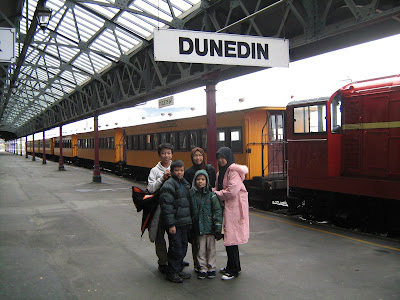
Dunedin railway station


Off to the Railway Station. Thought we could get on the hop-on/hop-off bus but apparently it’s not around in winter. Went to the Otago Museum Discovery Centre.

Discovery Centre Otago

Had a terrific lunch at Encik Sabri & Puan Laili’s place. The couple took us for a ride to Signal Hill, a lookout post for Dunedin, and Andy Bay. Saw people surfing in the cold. Wouldn’t have believed that anyone would surf in the cold it if I hadn’t seen it myself. Passed Gore and Clinton towns but no Bush around.

Day 11

Off to Milford Sound. From Te Anau, allow two hours because of the winding road to Milford Sound in Fiordland. Be sure you fill up the fuel as there’s limited supply once you left Te Anau. Passed through gushing streams and calm waters of the Eglington River along Alpine Road.


What we saw before entering a tunnel on the way to Milford Sound

Reached Milford Sound just in time for the 1.30 Red Boat Cruise. It’s worth the wait! Milford Sound was named as the eighth natural wonder of the world by Rudyard Kipling. Saw two breathtaking rainbows against the backdrop of cascading waterfalls. Fantastic weather despite it being winter. Free coffee/tea on board. Left for Te Anau again. Spent a night at Te Anau, next to the lake, a lovely place to explore. Best Top 10 facilities we've seen so far! Spanking clean bathrooms. It’s a pity we didn’t manage to see the Glowworm Caves tour that started at about 7pm as we were too tired.

Milford Sound: eighth natural wonder


Milford Sound: A view to behold

Day 12


Left Te Anau for Mossburn on the way to Queenstown. Encountered strong gust of wind near Mossburn. Along Lake Wakatipu, we drove right into a movie crew at Devil’s Staircase Lookout, filming, I supposed, a documentary. The water scenes for the movie “The Sea Horse: Legend of The Deep” were shot here. Had brunch of roti canai, sambal udang, curry gravy at Lake Wakatipu in Queenstown. Passed Arrowtown, once famous for the Gold Rush. Avoided the zig-zagging road to the ski area and took an alternative route instead. Crossed Kawarau River.
Stopped at an orchard and bought choc nuts, pistachios and fresh fruits. Reached Puzzling World (owned and ran by the family of Stuart Landsborough) on the way to Wanaka. It’s full of mazes, illusions and puzzles if you’re into these. Really thrilling and an educational treat. Spent the night at Wanaka and was told it was zero degrees Celsius. Previous night was even colder.

Puzzling World near Wanaka


The Hobbit Effect: Fact or fiction? One of the many illusions at Puzzling World

Day 13


Stopped at Lake Pukaki, the bluest waters I've seen with the majestic Mt Cook as backdrop.

Breathtaking: Bluest waters at Lake Pukaki

Reached Christchurch at almost dusk. Warm welcome by En Khairuddin (postgraduate student) and Pn Ita. Learnt that rubbish is only collected once a week here to discipline people to recycle as much as possible. Wish this is done in Malaysia. Spent a night at their house. Feted to a delicious dinner of sambal tumis and mackerel with soy sauce! Best sambal tumis ikan bilis I’ve had. Lovely family. Went to the International Antarctic Centre for a little dose of snow. You can experience the Antarctic Storm (starting at -8C), watch penguins at feeding time and go for the Hagglund Ride. The Hagglund is genuine, an amphibious vehicle used in the Antartic. It’s a 15-minute ride which takes you through steep mounds, deep crevasses and go slow in deep water. Thrilling for some but one ride was enough to make me feel sick because of the sudden drops and climbs. A bit like the roller coaster.

The chilling zone: Experience the Antartic snowstorm at -25 degrees

Great dinner with Ita & En Khairuddin again! Evening: Time to wrap up our visit and start packing.

Day 14

Took an early flight from Christchurch to Auckland. Had the most scrumptious blueberry muffin onboard. Goodbye New Zealand!

BONUS NOTES:

New Zealand is by far the country with the most stunning sights and the cleanest cities (even on Sundays when the cleaners are not around) I’ve ever seen. I’ve done quite a bit of traveling myself over the years and I must say NZ topped the list. The campervan offers the ultimate flexibility and more fun (my personal opinion of course) as you don’t have to lug bags in and out of hotels or make prior arrangements with cabs to get to your next destination. It’s an excellent choice if you want to fully engage with nature, which was what we had in mind in the first place. It’s more comfortable for passengers since there is more leg room. One table could stay intact while vehicle is in motion so kids could read/play board games while you’re on the move. It costs less than staying in hotels. Both Ahmad Fakhri and I are used to traveling since our student days so exploring a foreign country on our own is not something new to us. Plus you could stop at one of the many tranquil towns and scenic spots for a break, heat up some food and have a meal or nap anytime you wish. This helps especially when you cover many hours of driving a day.

You stand a good chance to witness firsthand the picture perfect and captivating sunrise if you‘re up before 8am. It’s crucial that you have ample rest the night before so you are alert the next day. This is especially true for the driver as you’ll need extra time to cover long distance. The campervan has a 90km/hr speed limit. The Kiwis are strict on traffic rules. There’s a high penalty for offences and if you are slapped with a fine, you’ll be left at least NZ200 poorer. Some traffic rules differ a bit from what we have in Malaysia e.g. in terms of right-of-way, so check this out before you start driving. Check if the campervan you’re booking is automatic or manual. Ours was manual, which can be a bit unnerving if you haven’t touched one in years. Also, some go on diesel and others on petrol. The campervan is very much a Do-It-Yourself thing, so you need to be a hands-on person with a good dose of the adventurous streak to boot.

On arrival, we registered as members of Top 10 Camping Sites. Most of the time we stayed at Top Ten as they provided good facilities e.g. toilets and showers, kitchen (if you don‘t want to cook in the campervan) and coin-operated laundry machines.

You do not need to bring too many clothes. It’s cold, you don’t sweat much and don’t have to bathe as frequently as in Malaysia. We brought four pairs of clothes each and even this was too much. Half of these were never worn.

I brought my laptop along but only managed to use it once. A safe is provided in the campervan to store valuables. The van has a built-in television set and DVD console but we hardly used these. We were just too engrossed with the surroundings.

If you are highly sensitive to the cold or have a child who is, it is better to be over prepared with long johns, sweaters, winter coats and thermal socks as it could get very chilly especially at night. Also, these days there are special waterproof trousers that will keep you extra warm. Got them from a shop at Jalan Loke Yew.

A big heartfelt THANK YOU to Richard and Roshidah, Encik Aziz and Kak Fatimah at Auckland, Thaharah and Taufiq (Palmerston North), Michelle (Wellington), Encik Sabri and Puan Laili (Dunedin), Encik Khairuddin and Ita (Christchurch) and all the Kiwis and Malaysians who welcome us with such warmth, generosity and hospitality and made our visit all the more memorable. Thank you, too, to the man at a certain ticketing counter who issued free tickets to our children. It's a pity I can't mention his name here; it might cost him his job.

Thursday, June 19, 2008

Children and Safety: It Pays to be Proactive

by Jamilah Samian

It was hot and humid, the fifth day of the midterm school holidays. Ahmad and I had spent the entire morning going from store to store hunting for baby items in anticipation of our second child. The shopping trip was great but tiring. Now we were at the main entrance of a fourteen-storey hotel-cum-shopping centre. Throngs of people sauntered in and out of the entrance. Ahmad and I clutched our shopping bags as we began to look for an eatery to have a quick bite for lunch. I was eight months pregnant. I had been on my feet all day long. My feet ached and my stomach rumbled. The sheer number of people milling around made me feel dizzy. As Ahmad had both hands full, I loosely held my three-year-old son’s hand.

Several minutes later, we spotted a promising looking restaurant and began to make our way there. Just twenty feet away on the right, I caught sight of a lift opening its doors. It quickly filled with people. Then, out of the blue and before I could stop him, I saw my little son run into the lift as its doors closed. I stood rooted to the floor in shock. “The boy ... he ran into the lift!” I gesticulated wildly to my husband, who, at that moment, was looking for a vacant table for us to sit.

“Wait for me right here,” Ahmad said and dashed to a security person who happened to be passing by. I saw him talking to the man rapidly and then both men rushed to another lift near the one my son went into. The man inserted a key into a panel in the lift just before they disappeared from my sight. I was beside myself with fear, worry and guilt. My legs felt like jelly. I wondered: Would my son get out of the lift at a certain floor? Would he be safe? Would they find him? The next ten minutes were sheer agony, until the two men reappeared ... with my crying son in tow. “We found him at the fourteenth floor all by himself,” Ahmad said in relief. The two of them had gone from floor to floor, calling my son’s name loudly at each stop. We thanked the security man profusely. His fast action had saved the day. By inserting the special key into the panel of the lift they used, it was deactivated i.e. it would not open its doors to anyone outside, enabling them to search and locate my son without interruption.

My son is now twenty-two and a final year engineering student. Yet I still shudder when I think of the incident. Losing young children in the shopping mall or any public place for that matter is a big deal and a nightmare for any parent, especially when it is crowded to the brim with people. Every now and then we read of paedophiles and other unscrupulous characters out on the prowl for young children. For many parents, the safety of their little ones is a top priority and a daily concern. How do you avoid such episodes from occurring? When it comes to safety at public places, being proactive is one of the recommended strategies. Being proactive means anticipating what could happen and taking preventive steps as follows:

- Read a story about a lost child. Young children usually find it easier to understand ideas through stories read to them. Concepts like “stranger” and “safety” are easier to grasp for preschoolers with the help of pictured books. For older children, if you come across an article in a newspaper about a missing child, share the story with them and have a discussion on what the parents and child could have done to avoid the incident. Or, what the child could have done if he finds himself lost.

- Remind young children to always hold your hand. This may seem obvious, but children are unpredictable and curious and get distracted easily with the numerous things they see at public places. If something grabbed their attention, they could stay rooted at a spot, oblivious to the fact that you had walked off the premises.

- Tell them to stay near you. If they could see you and you could see them comfortably, then they are at a safe distance from you. This would apply to certain places like theme parks and playgrounds where it may not be practical to keep holding their hands at all times.

- Tell them to stay where they are if they are lost. It is normally easier for you to look for them rather than the other way round as they might wander further and further away if they try to locate you once they realized they are lost.

- Take note of your child’s clothing before going out. This would help security personnel to identify your child if he or she gets lost in a crowded place.

- Tell them to not play hide-and-seek at the shopping centre. Some kids might get excited at the sight of rows upon rows of hanged clothing especially and may think it’s a good place to hide for fun.

- Tell your child never to accept gifts like toys or sweets from strangers. Food and drink items could be laced with drugs.

Think twice before you decide to bring the little ones on shopping trips during peak hours. The busiest times include the evenings after office hours and school holidays. It could be wiser to leave them with a trusted baby-sitter instead when you absolutely have to go out during these periods. Shopping with your young child is a far more pleasant affair during non-peak hours because he or she could help you choose the items you’re looking for – an opportunity for the two of you to bond and for him to learn. Besides, you would have greater peace of mind as you don’t feel harassed with the thought of rubbing shoulders with scores of other shoppers trying to squeeze through the same aisle ... or thinking that your child might dash and disappear into unknown territory like my son did.

- As published in ParenThink May 2008 issue

Thursday, January 03, 2008

For The Love of Logic and Mathematics

By Jamilah Samian

What would you do if your four-year-old throws a tantrum in the middle of a toy shop because you simply refuse to buy a toy that he wants? Depending on your style of parenting and your mood at the time, you might resort to punishing the child, for instance smacking him for what you see as distasteful behaviour. Or, you might want him to learn from the consequences of his actions by ignoring his pleas to tag along the next time you go shopping. Perhaps you might say, “The next time I go shopping, you will have to stay home. I am not happy that you screamed so much just because I refuse to buy the toy that you wanted.”

Of course, this method only works if you follow through with what you said you would do i.e. you actually did not bring him along on the next shopping trip. By explaining the consequences of his less-than-pleasant demeanor and following through, you are helping to nurture his ability to think in a logical manner. In this case, he would quickly learn that his action (throwing a tantrum) causes him to be grounded. Indeed, one way to nurture logical thinking in young children is by letting them learn the consequences of their behaviour. Learning the logical consequences of their own behaviour is a powerful way of instilling discipline among children. Logical thinking, then, is the ability to reason.

Keep in mind, though, that there is a big difference between what is misdemeanor and what is not for younger and older children. It is completely natural for a two-year-old to dip her fingers in a cake mixture out of curiosity if she is left alone with it or for a one-year-old to unravel a ball of thread or pull out tapes out of cassettes if he is allowed to grab hold of them. Any of these behaviours, though, would be unacceptable for a ten-year-old child. It is absolutely essential for us parents to be aware of the kind of behaviour to expect with each developmental stage a child is going through.

The ability to think logically is crucial for a child, not only because it helps to inculcate discipline but also due to the fact that thinking logically is an essential part of science and mathematics. In fact, so entrenched is logical thinking in mathematical concepts that Dr Howard Gardner, the originator of Multiple Intelligences, married these two together as one. In Dr Gardner’s own words, mathematical-logical intelligence is “the ability to detect patterns, reason deductively and think logically”.

When it comes to Mathematics, many of us tend to associate the field with numbers. While it is true that the foundation of Mathematics starts with the introduction of numbers, numbers is only a part of Mathematics. As children progress from preschool through secondary school and consequently to college, a considerable component of Mathematics is intricately linked with problem solving, which is associated in large part with logical thinking. For example, consider this simple mental arithmetic question on fractions that Jee, a ten-year-old, has to solve:

Aminah bought 30 eggs. She used 2/3 of the eggs to bake cakes. How many eggs had she left?

To solve this problem, Jee must be able to reason that the batch of 30 eggs, when divided into three portions, will give ten eggs per portion. Hence, since Aminah used 2/3 of the eggs, she used (2 x 10) eggs = 20 eggs. Notice that the first step Jee has to take is to decide that she needs to tackle the division bit (instead of adding, subtracting or multiplying) before she does anything else.

Mathematics is a subject that steadily builds on previous understanding. Because of this, it is crucial that your child has a solid foundation in Mathematics right from the beginning. Any confusion or misunderstanding will be carried forward to future years and as time passed, this confusion may be difficult to unravel. It is true that some children have a natural affinity for Mathematics, displaying a natural ease when dealing with Mathematical concepts like numbers and geometry and do not need much help. Yet others may need extra help to value similar ideas. Although it is also true that you cannot force your child to appreciate Mathematics, you can encourage him or her to develop a liking for Mathematical and logical thinking from a tender age with the following:

- Encourage your child to explore. An enquiring mind often starts with a passion to explore. Exploration for younger children is synonymous with touching. That is why it is good to let your child lay his hands on as many things as possible. If your child is still a toddler, this is a good time to put away or keep out of reach fragile items especially decorative ones to reduce the number of “No’s” from you! Plus, a child who is consistently told “No” will, after a while, naturally be inclined not to explore. Why try when all you get is a furious glare or a mouthful of scolding?

- Develop a love for problem-solving. Problem-solving starts with asking lots of questions. That is why you should make your best attempt to answer your child’s queries, no matter how trivial they may seem. For example, if you are making play dough and the recipe says to mix two cups of flour with one cup of salt, you might ask your three-and-a-half-year-old to help you find out how much salt you need if you use one cup of flour. The kitchen, by the way, is an excellent venue to start a child on mathematical and logical concepts as cooking and baking need plenty of weighing and measuring, exposing children to scientific paraphernalia like measuring cups, spoons and the weighing scale.

- Engage your child in counting activities. Ask your child, “There are four spoons on the table. We have six guests coming. How many more spoons do we need?” Or count the steps as you walk up and down the stairs. If you want to introduce the concept of multiplication, count in twos, threes, fours and so on. Or say you have just returned home from grocery shopping, you could say something like, “Nina, we have just bought two bottles of Vitagen here and in the fridge there are three bottles of them. How many bottles of Vitagen do we have now?”

- Introduce the concept of measurement. Take an object, for instance, a pencil or a marker pen and start measuring items around the house with it. This will expose your child to the concept of relative length. Change the object with which you do the measuring to make it fun. For shorter items, use smaller objects like erasers, pocket notebooks or a cork.

- Point out the shapes of objects. Geometry is part of Mathematics, and you can draw your child’s attention to the various shapes and sizes that are available around him. For example, let him hold a boiled egg before he eats it for breakfast and say, “The egg is oval in shape. Do you see anything else that’s oval?” Other shapes that are easily recognizable are rectangles, squares, circles and cubes. Compare the different shapes and sizes as you go along.

- Encourage him to play with blocks and structures. Three-dimensional structures figure strongly in Mathematics. Having a hands-on experience with 3-D (three dimensional) structures will help your child to form mental pictures of these items and strengthen his spatial intelligence.

- Help him to understand patterns. This is a concept not limited to Mathematics as it also exists in works of art and literature. Understanding patterns helps prepare your child for the concept of sequencing in Mathematics. For this, you can use a pattern of numbers and/or objects e.g. arrange three spoons followed by one fork followed by two cups. Repeat the pattern all over again.

Last but not least, a love for all things logical and Mathematical begins with the right attitude. Even if you never enjoyed Mathematics, do refrain from making any remarks which might influence your child to develop a dislike for the subject e.g. “Hannah, don’t worry about not being able to do that, dear. I was never good at Mathematics myself.” Or “There are so many people out there who become rich without ever learning Mathematics. So don’t bother!” Just because you never liked Mathematics doesn’t mean that your child is destined to have the same attitude. While your like or dislike towards Mathematics may have been formed by your previous experiences with teachers and other adults, your child deserves a fresh start. If your child thinks that Mathematics is something beyond his reach, he would naturally shy away from anything he sees as remotely associated with Mathematics. And because Mathematics is a big part of everyday living, that would lead to a major loss for him ... You wouldn’t want your child’s cold attitude towards Mathematics to develop into a self-fulfilling prophecy!

As published in Ibu dan Anak (ParenThink) December 2007 issue

Thursday, September 06, 2007

My Alternative E-mail Address

I am currently having problems with my streamyx line. If you wrote to me recently and haven't got any response from me, please forward your email to my alternative address at jamilah.samian@gmail.com

Inconvenience regretted. Thank you :)

Wednesday, September 05, 2007

Nurturing Creativity in Kids

by Jamilah Samian

What we say or do has far-reaching consequences on the ability of our kids to think and act creatively

Legend has it that ancient Singapore, or Temasek as it was then called, was once invaded by shoals of todak or swordfish. The sea creatures became such a menace that the King ordered his subjects to do away with them. On the appointed day, the brave people of the island descended upon its shores, keen to wipe out the todak once and for all. But it didn’t take them long to realize they were no match for the fishes. One by one the men fell as the agile todak pierced them with their razor sharp snouts. At that moment, a young boy named Hang Nadim came up with a suggestion: Instead of human shields, why not place banana trunks along the beach to snare the fishes? This turned out to be a brilliant idea! The swordfishes’ snouts were trapped and scores of lives were spared.

The story of Hang Nadim was but one of many that illustrate what happens when children are allowed to think creatively. Some of these kids went on to become great inventors. My guess is that, these idea generators had someone, quite likely a parent or guardian, who had backed them up, fired up their imagination and kept the creative juices flowing in them. It would be difficult to imagine life today without the many designs that are the fruits of labour of people who had concocted exceptional ideas. From mobile phones to the Internet to laser surgery, these inventions had made great improvements in our daily lives. Throughout the ages, creativity has turned impossibilities into realities. Even in times of war, it is the human trait of creativity that may have the last word on who wins or loses. Had someone not thought of the Trojan Horse, the nearly vanquished Greeks might not have conquered the Trojans and made history!

What is creativity anyway? Quite simply, creativity is bringing something new into being. While the debate rages on among psychologists whether creativity is something you are born with or is influenced by the environment, I believe there is much that we parents can do to nurture our children’s creativity. To this end, I would like to suggest that you:

- Entertain your child’s curiosity. Creativity thrives on curiosity. The more you encourage your child’s curiosity, the more creative he gets. Consider George de Mestral, the inventor of Velcro. In the early 1900s, he was a young boy who loved the outdoors and inventing. In fact, his creative streak won him his first patent for a toy plane at the tender age of 12. Each time after his outing with his dog, George was annoyed by the Burdock seeds (a prickly fauna) that stuck to his hunting pants and dog’s fur as it took him hours to remove them. George examined the seeds under the microscope and noticed that each seed had hundreds of tiny hooks that locked themselves onto the fabric of his pants or his dog’s fur. This gave him the germ of an idea and years after much experimenting, Velcro, the hook & loop fastener, was born.

- Tell your child that creativity has numerous forms. Because the media has a tendency to refer to certain expressions of artistic pursuits like painting, drawing, acting and dancing as forms of creativity, a child may think that he is not creative because he has no interest in any of these areas. This notion may be further reinforced at learning centres when the children who are able to paint or draw better are referred to as “creative”, which may unwittingly suggest that the other children who are not able to paint or draw as well are not creative. Tell your child that these only represent certain forms of creativity, and creativity encompasses a much wider meaning and possibility. In fact, it is the ability to creatively solve problems and overcome difficult situations that will help your child to not only survive but thrive in the long run.

- Encourage your child to think differently. Creativity often involves the ability to think out of the ordinary. It is the courage of those who dared to think in contrasting ways that has continually made a lasting impact to human lives. Children by nature are born creative. However, to remain creative, they need constant motivation. This is because, creativity involves two processes i.e. thinking and producing. All you have to do is to provide a safe environment for this to happen. For example, if you see your child stacking up a set of wooden blocks horizontally again and again, ask him, ”Is there a way to arrange them another way?”

- Be prepared to invest. Your child might need your help to provide the resources to turn his ideas into reality. For this to occur, you might have to set aside your time and money. Think of the time and money that you incur as an investment rather than cost. Even if things don’t work out as expected, assure your child that it’s okay ... he would have learnt something new along the way.


I must tell you, however, that the story of Hang Nadim had a cruel twist to it. His smart thinking made him a subject of both admiration and envy in the island. One day, someone convinced His Majesty that the boy will be a threat to his influence and power. In the end, Hang Nadim was ordered thrown into the sea. While we parents may not treat our children the way the King did, some of us, who have been conditioned to think that parents always know better, may feel threatened with the unconventional thinking that they might come up with. We may even feel defensive or ruffled if we find ourselves unable to respond adequately to our children's queries and their many questions of "Why". The thing is, children have to learn that parents do not have the answers to everything. To keep the creative strain in your child alive and well, do not ridicule or laugh at him when he conceives thoughts that seem crazy or out of this world. Without your timely support and understanding, your child's creative aspirations may remain just that - an ignored figment of his imagination that will soon fade into nothingness and never see the light of day.

Published in Parenthood magazine, September 2007 issue

SOHO Conference Sept 3 2007 at Berjaya Times Square

I facilitated the "Working from Home: Smart Strategies for a Thriving Home Business and a Balanced Life" workshop at the recent SOHO (Small Office Home Office) Conference held on September 3rd 2007 at Berjaya Times Square. Many of the questions raised by participants brought back memories of how difficult it was for me to begin working from home 14 years ago.

At that time, I had no one to turn to ... I didn't know who to ask when the going got tough! I recall that the decision to work from home was made because it made sense to me; although at that time it did not to many others, friends and family included.

The 1.5-hour session did not allow much to be covered - I only managed to provide glimpses and a general idea of how to start and run a SOHO. Certainly, running a SOHO is not for everyone. It only works if you truly love what you do and are determined to succeed. Plus, you MUST have a healthy dose of positive thoughts on a daily basis!

The session served as a preview for a comprehensive workshop to be held later this year, most likely in December. Look out for an announcement in this blog as well as at e-homemakers!